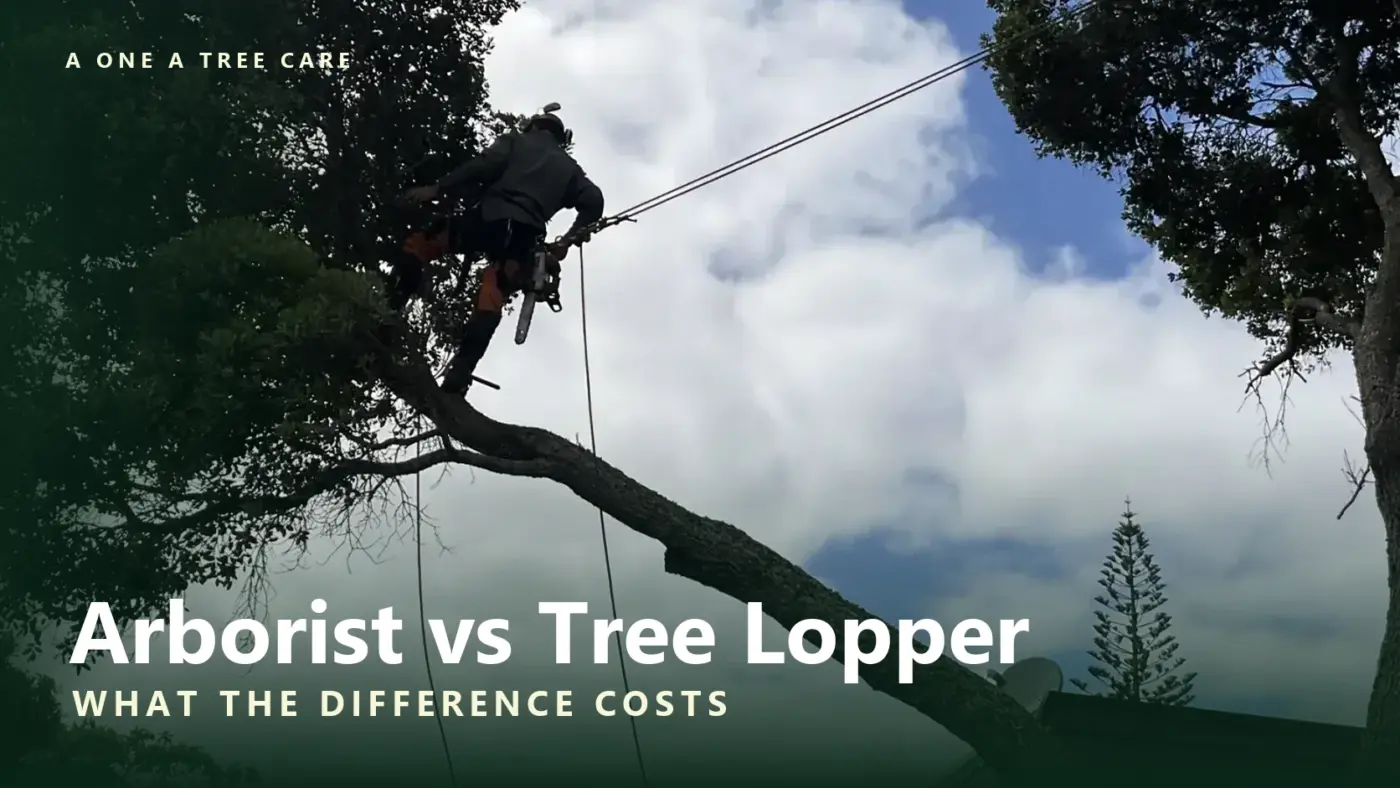
Anyone in New Zealand can answer the phone and call themselves a tree lopper. Nobody has to hold a qualification to put a chainsaw in a van and quote on your tree. That is the whole difference, and it usually shows up twice: once in the price, and again a year later in the tree.
This page explains what the qualifications actually are, how to check one in about two minutes, and when the cheaper option is genuinely fine.
Would you rather have it done for you? See our tree removal in Auckland — free on-site quote from certified, fully insured arborists.
Level 4 certified
Need an Experienced Auckland Arborist?
An honest assessment of what the tree actually needs — including when the answer is that it can stay.
What a Qualified Arborist Has That a Lopper May Not
Arboriculture in New Zealand has a formal qualification ladder, taught at polytechnics.
| Level | Qualification | What it covers |
|---|---|---|
| Level 3 | New Zealand Certificate in Horticulture (Arboriculture) | Ground work, basic tree care, equipment, safety |
| Level 4 | New Zealand Certificate in Horticulture Services (Arboriculture) | Climbing, rigging, pruning to standard, work planning |
| Level 5 | New Zealand Certificate in Arboriculture | Tree assessment, complex removals, diagnosis |
| Level 6 | Diploma in Arboriculture | Consultancy, reports, advanced assessment |
Level 4 is the practical threshold for someone working in your tree rather than on the ground beneath it, because that is where climbing and rigging are formally assessed.
The Industry Body
The New Zealand Arboricultural Association has represented the industry since 1989 and is a chapter of the International Society of Arboriculture. It maintains a Registered Master Arborist designation, which requires meeting its quality assurance and professionalism standards, and it runs a public directory of arborists.
Its own advice to tree owners is direct: using a Registered Master Arborist is how you can be confident you are dealing with a qualified and experienced arborist.
How to Check in Two Minutes
Before accepting any quote:
- Ask what level they hold, and in what. “Qualified” on its own means nothing. “Level 4, New Zealand Certificate in Horticulture Services (Arboriculture)” means something specific.
- Ask for the certificate, or the name it was issued in. A real qualification has a holder, a level and an issuing institution.
- Ask for a certificate of currency for public liability insurance. Not a policy number, the certificate. Check the sum insured and the expiry date.
- Ask who is climbing. The person quoting is not always the person in the tree.
- Check the NZ Arb directory if they claim membership.
A business that holds these answers readily will give them in one message. Hesitation is the answer.
Where the Price Difference Comes From
A lower quote is not automatically a worse one, and it is worth understanding what the gap usually represents.
- Insurance. Public liability cover for tree work is a real annual cost. A quote that does not carry it is cheaper for exactly that reason, and the risk transfers to you.
- Equipment and rigging. Lowering a limb under control takes gear and a groundie. Dropping it does not.
- Clean-up and disposal. Green waste has a disposal cost. Check whether it is in the quote or added later.
- Time. A tree taken apart in sections near a structure takes longer than one felled in an open paddock. The same tree can be two different jobs.
Level 4 certified
Need an Experienced Auckland Arborist?
An honest assessment of what the tree actually needs — including when the answer is that it can stay.
When a Lopper Is Genuinely Fine
This is not an argument that every job needs a Level 4 climber. A small tree in an open space, well clear of any structure, boundary or line, cut from the ground, is a straightforward job and the cheaper quote may be entirely appropriate.
The qualification matters when any of these are true:
- Someone has to climb or be lifted into the tree
- The tree is within reach of a house, shed, fence, glasshouse, vehicle or neighbouring property
- There are overhead lines anywhere near the work
- The tree is to be kept, because pruning done badly cannot be undone
- The tree may be protected, scheduled or subject to a planning overlay
That fourth one is the most commonly underestimated. A removal that goes wrong is dramatic and obvious. A bad prune is quiet: the tree responds with weak regrowth, and the cost arrives three years later as corrective work or a removal that was never necessary. Our tree pruning in Auckland is priced on what the tree needs rather than on how fast the branches can come off.
Get a Free Assessment
We are Level 4 certified and fully insured, and we will tell you when work is not needed. If a removal is the right answer we will say so, and our tree removal in Auckland quotes set out exactly what is included.
Level 4 certified
Need an Experienced Auckland Arborist?
An honest assessment of what the tree actually needs — including when the answer is that it can stay.
Frequently Asked Questions
Is “arborist” a protected title in New Zealand?
There is no licensing regime that stops someone calling themselves an arborist or a tree lopper. The qualifications are real and assessed, but holding one is voluntary, which is why asking the question matters.
What qualification should I expect for climbing work?
Level 4 is the practical threshold, because that is where climbing and rigging are formally assessed. Level 5 and the Level 6 diploma go further into assessment and diagnosis rather than physical work.
Does a qualified arborist cost more?
Often, though not always. The gap usually reflects insurance, rigging equipment, a second crew member and disposal. Compare what is included rather than the headline figure.
My tree only needs a trim. Does this still matter?
More than for a removal, in a sense. A tree you are keeping has to live with the cuts. Pruning done to a standard retains the tree’s structure; pruning done by eye frequently does not, and the damage is not reversible.
How do I check a Registered Master Arborist?
NZ Arb publishes a directory of arborists. Registration requires meeting its quality assurance and professionalism standards.