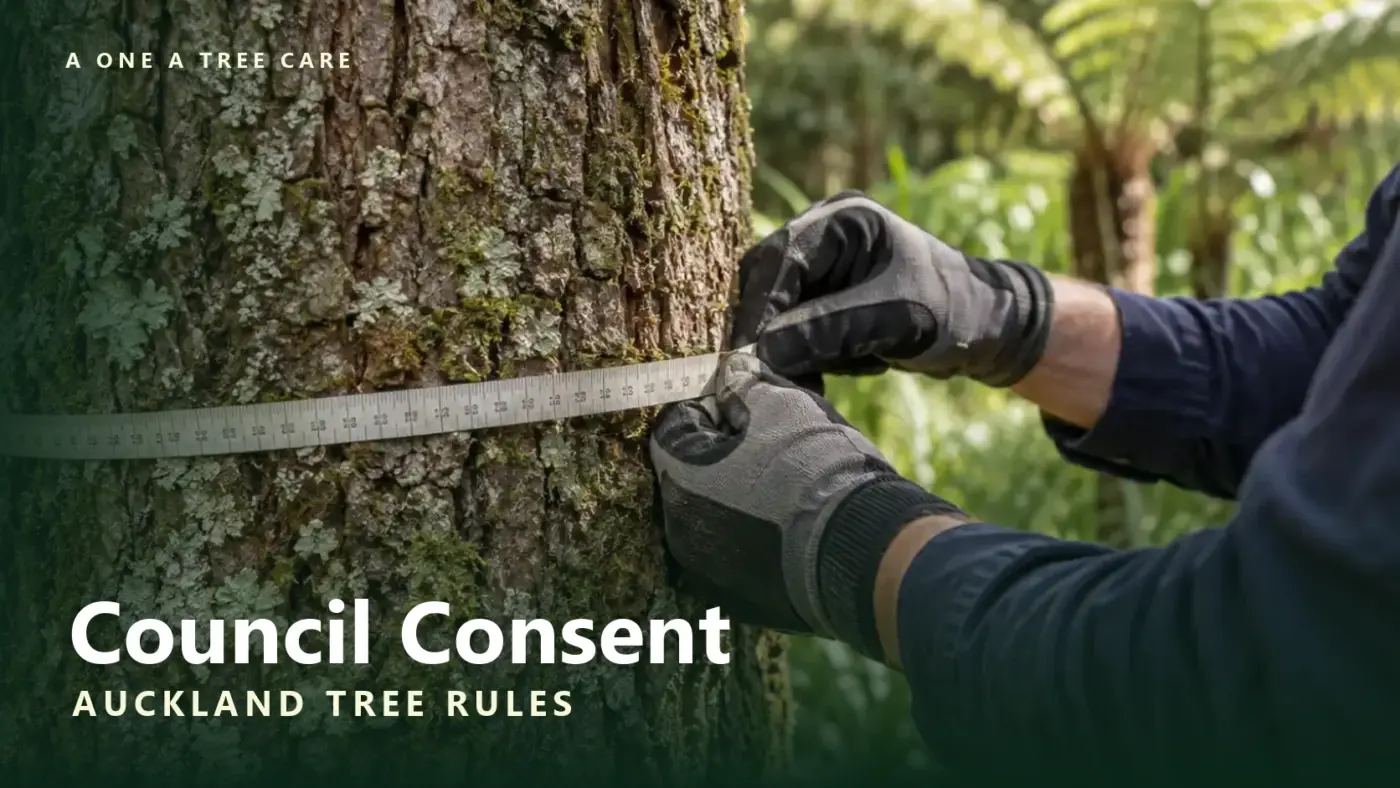
The honest answer is that it depends on your property, and you can usually find out in about fifteen minutes without ringing anyone.
Most trees on private residential land in Auckland can be removed without resource consent. But several things can change that for a particular tree, and they are tied to the property rather than to the species or the size. Two identical trees on neighbouring sections can have different answers.
Would you rather have it done for you? See our tree removal in Auckland — free on-site quote from certified, fully insured arborists.
Free, no-obligation
Need Professional Tree Removal?
We assess the tree on site, quote in writing, and take care of consent checks before anything is cut.
Why There Is No Simple Yes or No
People expect a rule along the lines of “anything over six metres needs consent”. Auckland does not work that way. Protection attaches to a specific tree on a specific site: whether it is listed in the council’s schedule of notable trees, whether the land sits under a planning overlay, whether a past resource consent placed a condition on it.
That is why a contractor who answers “nah, you’re fine” over the phone without seeing your address has not actually answered the question. They cannot have, because the information is tied to your property and they have not looked it up.
The Three Checks
1. Look the property up on the council’s maps
Auckland Council publishes two free map tools. GeoMaps is the general property viewer, and the Unitary Plan viewer shows the planning overlays that apply to a site.
Enter the address and look for anything flagged over the property: a notable tree marker, an ecological or heritage overlay, a coastal or riparian strip.
One caution worth knowing. A map marker shows that a scheduled tree is present on or near a site, but it does not always pinpoint which tree. If a marker appears, the schedule entry itself is what identifies the tree, not the dot on the map.
2. Read the property file or LIM
The council holds a property file for every site, and a LIM report draws the relevant parts together. These show scheduled trees, overlays and any conditions attached to earlier consents, including a covenant or consent condition requiring a tree to be retained, which will not appear on a public map at all.
If you are buying the property this is already part of your due diligence. If you have owned it for years, it is worth a look before any significant tree work.
3. Have it confirmed before the work is booked
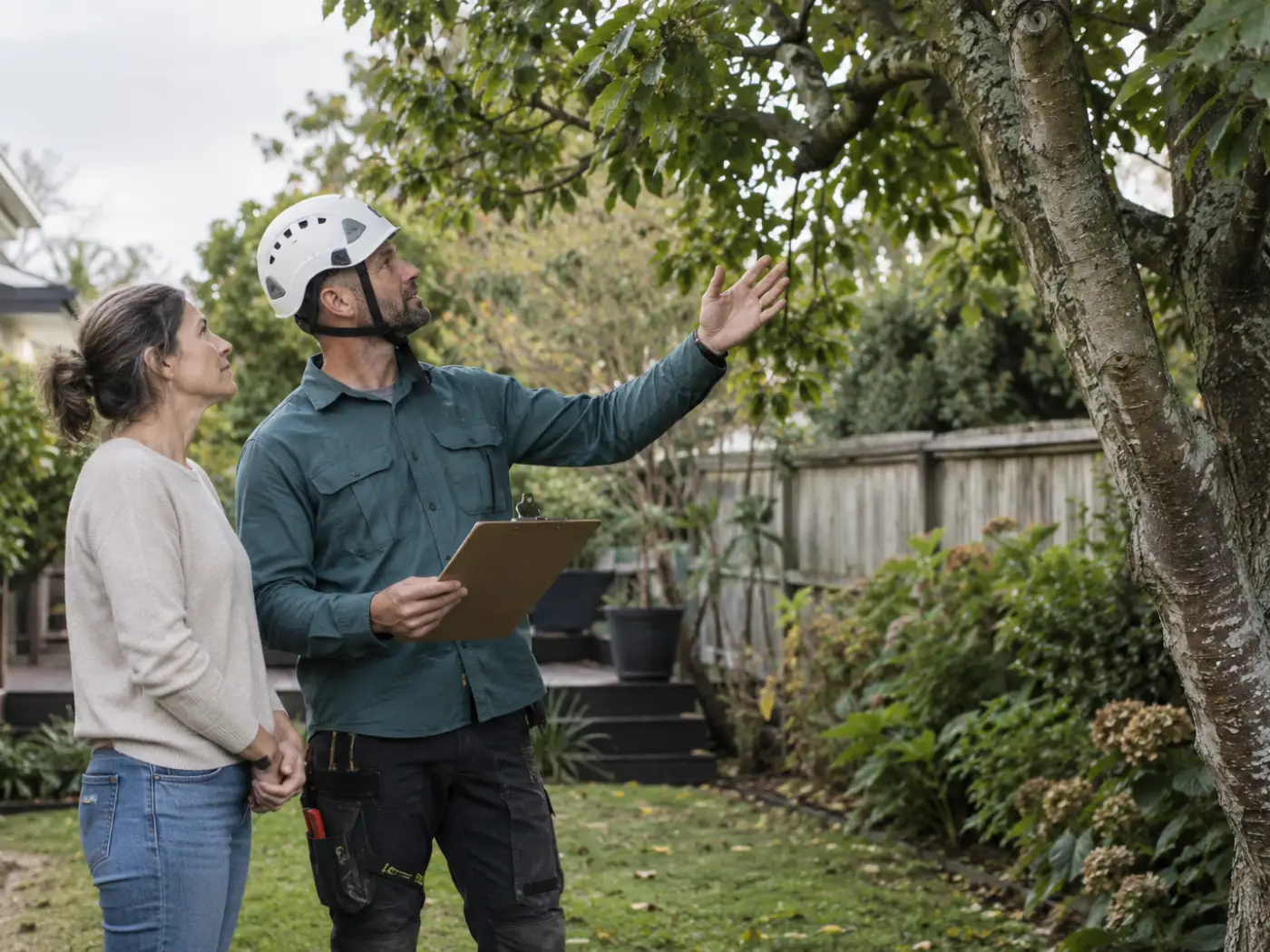
Any arborist quoting on a removal should be checking this as part of the quote rather than leaving it with you. Ask directly whether they have checked if the tree is scheduled or the site carries an overlay. If the answer is vague, that tells you something about how the rest of the job will be handled.
What Can Make a Particular Tree Protected
These are the categories to look for rather than a complete list, and whether any of them applies to your tree is exactly what the checks above establish.
- Scheduled notable trees individually listed in the Unitary Plan
- Planning overlays covering ecological, heritage or character areas
- Riparian and coastal margins along waterways and the coast
- Resource consent conditions and covenants requiring a tree to be kept
- Trees that are not on your land, covered below
Significant pruning and root cutting can fall under the same provisions as removal where a tree is protected. “I’m only trimming it” is not automatically outside the rules.
Free, no-obligation
Need Professional Tree Removal?
We assess the tree on site, quote in writing, and take care of consent checks before anything is cut.
Trees That Are Not Yours
Two situations come up constantly and both sit outside your control.
Street trees. A tree on the berm or road reserve belongs to the council, even when it is directly outside your gate and filling your gutter. Work on it is arranged through the council, not privately.
A neighbour’s tree. Where branches cross the boundary there are longstanding principles about what you may cut, but they come with real limits, and acting on a protected tree or on your neighbour’s side of the boundary can create a dispute you did not need.
If the Tree Is an Immediate Danger
Provisions exist for genuine emergencies: a tree that has come down, split, or is actively threatening people or property. These are narrower than people assume, and “it looks like it might come down one day” is not the same thing.
If a tree is an immediate hazard, deal with the hazard and record the condition with photographs taken before the work and a note of what made it urgent. If it is not immediate, the checks above are quicker than the consequences of skipping them. For a tree that has already failed, our emergency tree services in Auckland run around the clock.
Get the Status Checked With the Quote
We check the schedule and the overlays as part of quoting, before any work is booked. If a tree turns out to be protected we will tell you, and we will tell you what that means for what you wanted done. Our tree removal in Auckland quotes include that check as standard.
Free, no-obligation
Need Professional Tree Removal?
We assess the tree on site, quote in writing, and take care of consent checks before anything is cut.
Frequently Asked Questions
Is there a height or trunk size that automatically needs consent?
No. Protection in Auckland attaches to specific trees and specific sites rather than to a general size threshold. The property checks are what give you the answer.
The council’s map shows a marker near my tree. Does that mean mine is protected?
Not necessarily. A marker indicates a scheduled tree is present in that area but does not always identify which one. The schedule entry describes the tree, and that is what to check against.
Does pruning need consent if removal would?
It can. Where a tree is protected, significant pruning and root cutting may fall under the same provisions. Light maintenance and removal are not always treated the same way, which is why the specific status matters.
Who is responsible for a tree on the berm?
The council. Street and road reserve trees are council assets and work on them is arranged through the council rather than privately.
How long does it take to find out?
The map check takes a few minutes. A property file or LIM takes longer and carries a fee, but it is the one that surfaces consent conditions and covenants that maps do not show.