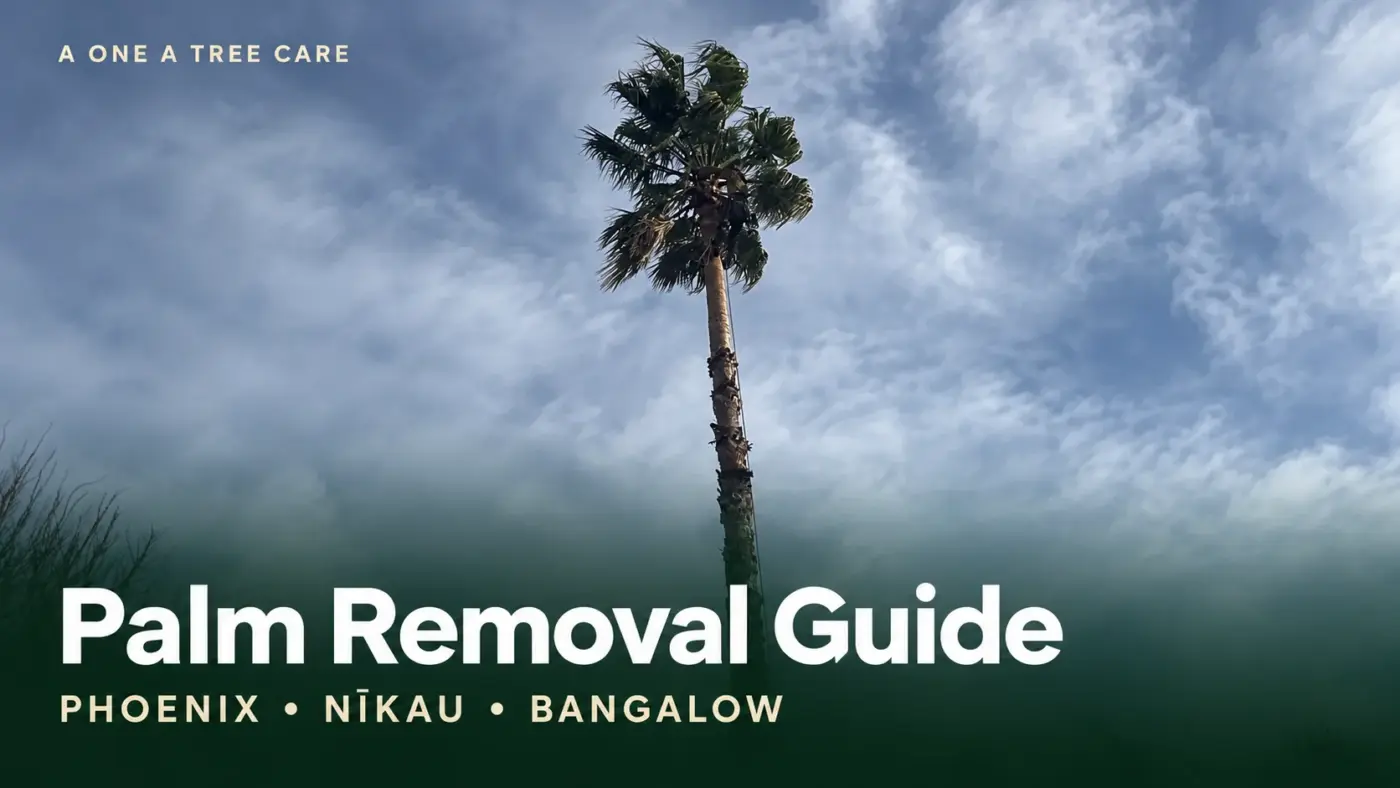
Phoenix, nīkau and bangalow palms can require different handling and checks before work begins. Phoenix palms have spiny leaf stalks; nīkau needs to be distinguished from introduced palms; and Auckland has pest-management rules for bangalow. Identifying the palm comes before deciding whether maintenance or removal is appropriate.
This guide explains what those differences mean for a property owner. For an assessment, removal options and a written price, see our palm tree removal service in Auckland. The species helps shape the plan, but it does not replace an assessment of the actual site.
Would you rather have it done for you? See our palm tree removal in Auckland — free on-site quote from certified, fully insured arborists.
Free, no-obligation
Need Professional Tree Removal?
We assess the tree on site, quote in writing, and take care of consent checks before anything is cut.
Phoenix, Nīkau and Bangalow at a Glance
| Palm | Identification starting point | Main planning consideration |
|---|---|---|
| Phoenix / Canary Island date palm Phoenix canariensis |
Stocky form, diamond-patterned leaf scars and spiny leaf stalks | Handling the crown and spines; checking pest rules and property protections separately |
| Nīkau Rhopalostylis sapida |
Native palm with a conspicuous crownshaft beneath the leaves | Correct identification, retention options and site-specific protection checks |
| Bangalow Archontophoenix cunninghamiana |
Introduced palm that can be confused with nīkau | Species confirmation and Auckland pest-management requirements |
These are identification prompts, not a definitive identification key. The source references are Auckland Council’s Phoenix and bangalow profiles, and the New Zealand Plant Conservation Network’s nīkau profile. Clear photographs of the whole palm, trunk and crown help an arborist identify it.
Phoenix Palms: Spines and Crown Handling
A Phoenix palm’s leaf stalks carry sharp spines. Auckland Council’s species guidance highlights the injury risk and recommends qualified arborists for work beyond the seedling stage. A palm that looks low enough to reach can still present a difficult handling problem.
For removal planning, the surroundings matter as much as the visible trunk. A crown extending over a path, parked cars or a neighbouring garden needs a plan for how material will be handled and where it can go. The assessment should cover the whole working area.
Practical information from the owner helps: which entrances must remain available, where vehicles can move, and which garden features need protection. There is no single removal method for every Phoenix palm. The appropriate approach depends on its condition, size and the available space.
Nīkau and Bangalow: Identification Before Action
Nīkau is a native palm; bangalow is introduced. Confusing them can lead to the wrong discussion about retention, replacement and pest management. The trunk alone may not provide enough information, particularly in a cropped photograph.
Where the identification is uncertain, leave that decision to the site assessment rather than labelling a palm from an online comparison. A view of the crown, leaf arrangement and any visible fruit can be useful, provided photographs can be taken safely from the ground.
For nīkau, native status is a reason to consider its value and setting carefully, but it does not by itself establish the property’s legal rules. Notable-tree status, ecological protections and previous consent conditions are separate checks.
For bangalow, Auckland Council’s current pest profile sets restrictions on activities including breeding, distribution, release, sale and planting. The detailed rules include qualifications, so relocation or giving a palm away should not be assumed to be an available alternative. The linked council profile is the place to check the current requirements.
Pest classification and permission to remove a particular specimen are also different questions. A removal proposal still needs the relevant property checks. The council’s pre-application guide outlines tree and location checks, including notable trees, ecological areas and consent conditions.
Free, no-obligation
Need Professional Tree Removal?
We assess the tree on site, quote in writing, and take care of consent checks before anything is cut.
How the Site Changes the Removal Method
A palm beside open ground and one enclosed by a deck can need different work plans even when they are the same species. Available space, overhead obstacles, access for equipment and the route for removing material all matter.
Sectional removal may be appropriate where the palm must be taken down in smaller pieces. Other sites may support a different method or specialist access equipment. This is an assessment decision, not something that can be selected reliably from the species name or an approximate height.
Climbing spikes: pruning and removal are different
The International Society of Arboriculture advises against climbing spikes when pruning palms because they leave permanent wounds. That guidance protects a palm which is being retained. For complete removal, the arborist selects the access method for the assessed job; preserving the trunk is no longer the same objective.
Material handling and the next use of the space
Fronds, trunk sections and stump material should be accounted for separately in the scope. Their destination depends on the material, equipment and receiving facility; a removal should not come with an unsupported promise that everything becomes garden mulch or firewood.
The intended next use matters too. Leaving a stump, arranging stump grinding and preparing an area for new construction are different endpoints. A photograph or simple plan of the intended path, planting bed or other feature helps define the handover before the work begins.

Frond Maintenance or Complete Removal?
If the palm remains suitable for the space and the problem is falling material, a maintenance assessment may be the appropriate starting point. Removal becomes a separate discussion when the palm’s condition, location or the planned use of the site calls for it.
A useful recommendation explains the intended result, the material involved and any follow-up. It should distinguish a tidy-up from complete removal and identify whether further ground work is included. That gives you a practical choice without assuming every untidy palm must go.
For an assessment, contact A One A Tree Care with your suburb, overall photographs and what you want to change. Our palm service page covers the removal enquiry and pricing process.
Free, no-obligation
Need Professional Tree Removal?
We assess the tree on site, quote in writing, and take care of consent checks before anything is cut.
Frequently Asked Questions
Can I identify nīkau and bangalow from the trunk alone?
A trunk photograph may be insufficient. Images of the whole palm and crown provide more context. Where identification affects a work or replacement decision, have it confirmed during the assessment.
Does being a pest palm mean removal is automatically allowed?
No. Pest-management requirements and property-specific tree protections are separate checks. The applicable rules and any required approvals should be established before work.
Does every tall palm need a crane?
No single method suits every site. The removal plan depends on condition, available space, nearby structures and equipment access as well as height. Specialist equipment is selected when the assessment shows it is needed.
Are climbing spikes suitable for pruning a palm that will stay?
ISA guidance advises against them because they permanently wound palm trunks. Complete removal has a different objective, with access selected by the arborist for the assessed job.