
What Does Section Clearing Cost?
Would you rather have it done for you? See our tree felling in Auckland — free on-site quote from certified, fully insured arborists.
Free, no-obligation
Need Professional Tree Removal?
We assess the tree on site, quote in writing, and take care of consent checks before anything is cut.
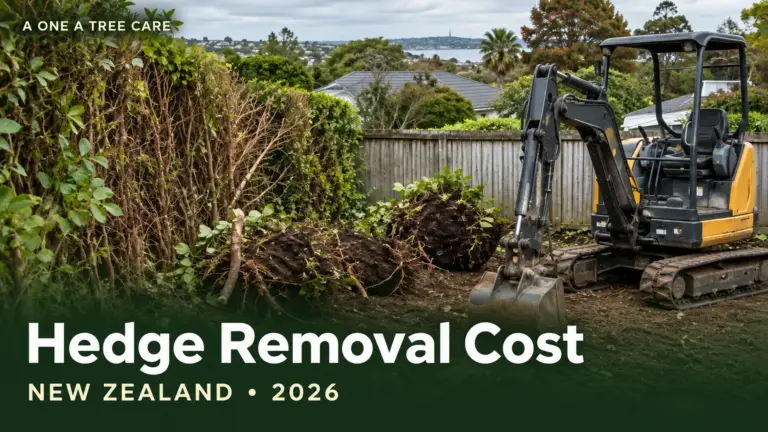
For early planning, a published NZ contractor guide places residential section clearing around NZ$1,500–$6,000, with heavier work costing more. This is a cross-region benchmark, not a measured Auckland average or A One A Tree Care rate. Your Auckland price needs a defined scope and site assessment.
The range comes from Peard Excavation’s section-clearing guide, a contractor serving Bay of Plenty, Waikato and Coromandel. Its pricing passage does not establish GST treatment. Auckland specialists such as Tree King instead offer tailored pricing, so confirm a complete local quote.
“Clear the section” can mean restoring access to an overgrown garden or removing vegetation ahead of development. It does not automatically include demolition, contaminated material, bulk earthworks or a finished building platform. Start by describing the next use of the site, then identify the clearing needed to get there.
For a homeowner, the endpoint might be a manageable garden. For a builder, it may be a marked area ready for the next contractor to inspect. Those endpoints need different instructions, even if the visible vegetation looks similar at the start.
Costs by Section Size and Vegetation
Section area is useful enquiry information, but the area actually being cleared matters more than the title area. Mark the work zone on a plan and identify trees or planting to retain. The table separates budget evidence from the measurements needed to obtain a price.
| Site and vegetation | Budget basis | Information needed |
|---|---|---|
| Small patch, garden edge or access strip | Local quote; no verified universal minimum | Area or length, vegetation type and disposal scope |
| Residential section with ordinary clearing scope | NZ reference: $1,500–$6,000, not an Auckland rate | Actual area to clear, access, retained features and intended finish |
| Dense woody growth or mature trees and stumps | Individual quote; may exceed the reference band | Tree inventory, stem sizes, terrain and material handling |
| Large site or staged development clearance | Project-specific assessment and programme | Plans, consent conditions, staging and contractor handovers |
A 500m² property is not a 500m² clearing job if the house, driveway and retained garden occupy much of it. Likewise, two equal areas can contain very different material. Record the work area separately from the property size rather than applying a generic rate to the whole section.
Hourly rates and fixed prices
The Peard guide also gives a general machine-and-operator reference of $80–$150 an hour. That is not an Auckland all-inclusive clearance rate. Transport, different machinery, disposal and specialist tree work need their own confirmation. Do not multiply it by a guessed number of hours and treat the result as a firm budget.
For a defined site, request a fixed quotation where possible. If an exploratory or changing scope is charged hourly, agree the team and machinery covered, chargeable travel, estimated allowance and a point at which further approval is needed. Keep a record of changes to the work area.
Access and material hidden in vegetation
Provide photographs of the entrance and internal route, not only the overgrowth. Note gates, steps, shared access and overhead obstacles. Tell the assessor about known wire, concrete, dumped material or old structures so those items can be considered before machinery is selected.
For illustration, an open patch of scrub and a narrow strip containing old fencing should not be given the same scope merely because they cover equal areas. The contract should explain how unexpected material is identified, priced and authorised during clearing.
Clearing Before Building or Subdividing
Before booking, share the relevant site plan and identify who can authorise decisions. A developer, property manager and builder may each have different priorities. One agreed plan helps prevent the contractor receiving conflicting instructions about what stays and what goes.
Mark retained trees, fences and access routes clearly. If tree protection measures are required, have them specified before work begins. Do not leave the operator to infer the intended development boundary from a rough verbal description or a photograph.
The next contractor’s required starting condition should guide the handover. Vegetation removal is not the same as geotechnical acceptance, engineered fill or foundation preparation. The designer or relevant specialist should specify below-ground requirements where future structures are involved.
Make the handover measurable. For example, identify the area cleared, material retained, material removed and any exclusions awaiting further instruction. Use dated photographs and an agreed inspection point so the following trade knows exactly what has been completed.
For an occupied site, include practical arrangements for residents, staff or deliveries. Agree which routes remain open and who receives updates if weather or newly exposed material changes the programme. The cheapest proposed sequence is of limited value if it prevents the property from functioning when access is needed.
Where the work includes suitable open-site tree removal, our tree felling service in Auckland is relevant. The method must still follow the site assessment; proximity to buildings or retained features may require a different approach.
For land clearing and arborist work on the North Shore or elsewhere in Auckland, include suburb-specific access details rather than assuming a regional price difference. A narrow entrance, steep rear section or limited truck stopping space is more useful information than the suburb name alone.
Free, no-obligation
Need Professional Tree Removal?
We assess the tree on site, quote in writing, and take care of consent checks before anything is cut.
Consent, Protected Trees and Work Boundaries
Check the property’s restrictions before vegetation is removed. Auckland Council’s pre-application guide identifies notable trees, Significant Ecological Areas, sensitive locations near water and previous consent conditions among the relevant checks. A general intention to build does not settle which vegetation can be cleared.
Your planner or council contact can confirm the requirements for the proposed work. Keep any necessary approvals and conditions available to the contractor, and make clear who is responsible for confirming compliance before the job begins.
Include access permissions and boundary uncertainty in the discussion. If equipment or workers need to enter another property, arrange that access rather than assuming it follows from your clearing contract. Where vegetation ownership is disputed, resolve the issue before authorising removal.
Tell the assessor about streams, steep banks, drains or areas you need protected from disturbance. Clearing vegetation and moving soil may have different implications. Request the relevant specialist input rather than relying on an online cost guide as approval for the work.
What Happens to the Cleared Waste?
Decide the material destination before comparing quotes. A clearance that retains suitable mulch on site is a different offer from one that loads and removes everything. For background on handling tree material, see our chipping, mulching and debris options.
A useful waste schedule separates woody vegetation, logs, stump material, soil and unrelated rubbish. Check which categories are included, how quantities are allowed for and what happens if a hidden pile of mixed waste is uncovered.
Keep material only when its proposed location and use fit the next stage. A mulch pile may be useful in a garden but inconvenient where machinery must work tomorrow. Discuss suitability for reuse; do not assume all cleared plants, diseased material or mixed debris can be spread on site.
Compare the whole handling process, not just the cutting charge. Loading, cartage, disposal fees and final tidying all belong in the comparison. If removal is charged by load, confirm how that load is defined and whether a change in quantity requires your agreement.
Getting a quote that is easier to compare
Prepare a short briefing for each contractor: site address, marked work area, photographs, known obstacles, retained features and the required finish. Attach relevant plans and state any deadline. Give each provider the same information so price differences can be discussed on a common basis.
Separate lines for vegetation clearance, specialist tree work, stump treatment, waste removal and later earthworks make the quote easier to compare. You do not need a complicated schedule for a small garden, but you should be able to see what your accepted total buys.
Request a free site assessment from A One A Tree Care and explain whether you are preparing for sale, landscaping or development. Confirm the scope, GST, programme and handling of changes before work is booked.
Free, no-obligation
Need Professional Tree Removal?
We assess the tree on site, quote in writing, and take care of consent checks before anything is cut.
Frequently Asked Questions
Can section clearing be priced per square metre?
Area can be part of an estimate, but it must be tied to the vegetation, terrain and required finish. No dependable universal Auckland rate per square metre was established for this guide. Use measured area to support a tailored quote rather than as the only pricing input.
Does clearing include stump removal?
Only if the scope includes it. Identify each stump and agree what the next use requires. Where the ground has to be clear for building or replanting, stump grinding is quoted as its own line. The designer or following contractor should specify below-ground clearance where structures or other construction are planned.
Will the site be ready for building afterwards?
Clearing is one part of preparation. Confirm separately any surveying, earthworks, drainage, ground testing or engineered preparation required. The clearing handover should describe completed work without implying approval of a building platform.
Can material stay on the property?
Suitable material may be retained where agreed and appropriate, but confirm its type, quantity and location. Keeping material is not automatically compatible with the development plan, and it should not be used to hide an incomplete disposal scope.