What Does Tree Pruning Cost in NZ?
Would you rather have it done for you? See our tree pruning in Auckland — free on-site quote from certified, fully insured arborists.
Qualified arborists
Want It Pruned Properly?
Correct cuts, the right season, and the full clean-up included — without taking more off the tree than it needs.
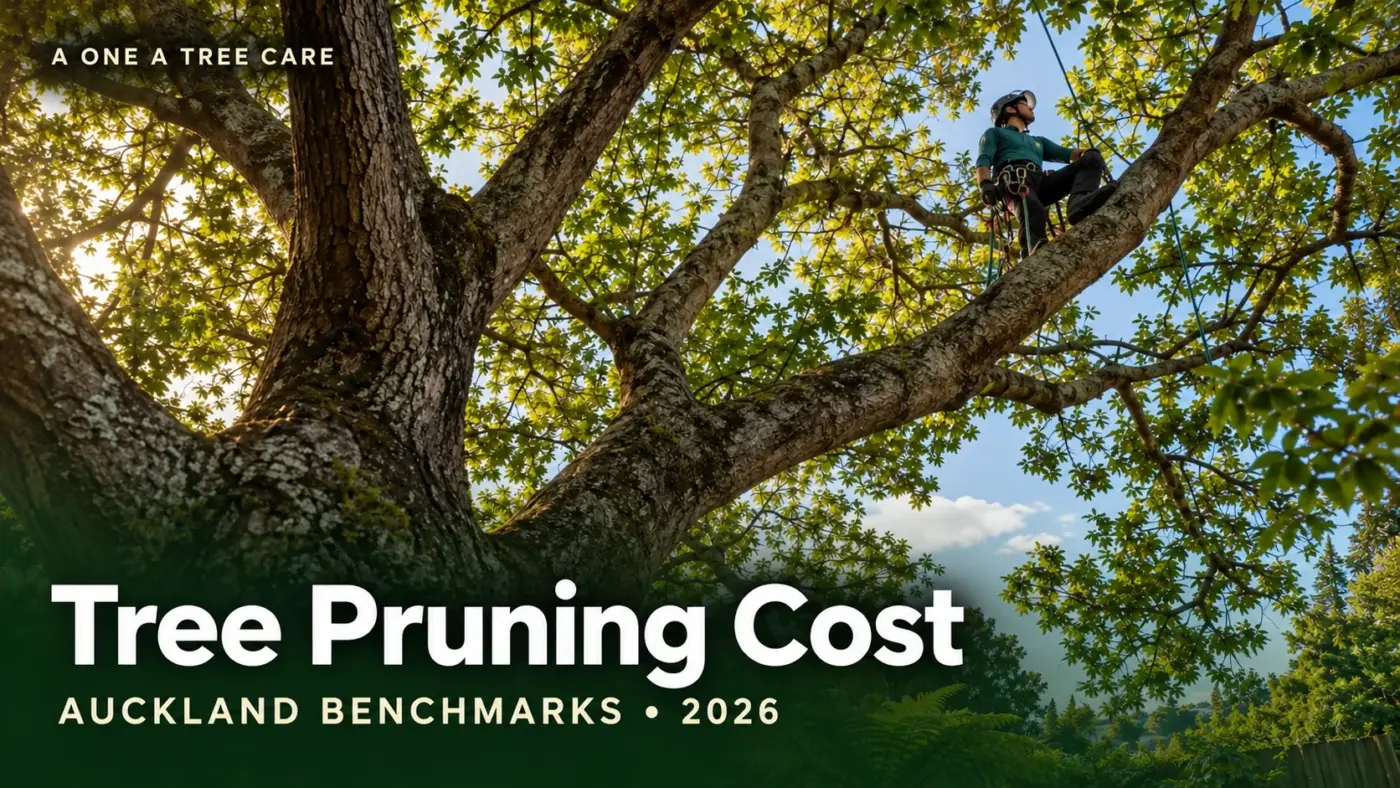
These benchmarks come from Auckland providers; other regions may differ. For budgeting, allow roughly NZ$350–$800 for small-tree or limited pruning, $800–$1,800 for a medium tree, and $1,800–$4,000 for a large tree. Technically complex projects can exceed $4,000. These are published competitor benchmarks, not A One A Tree Care’s confirmed prices.
New Zealand does not have one standard tree pruning price. This guide draws on Auckland providers, so use it as a starting point locally and obtain a quote in your own region. The required cuts, access and disposal arrangements matter when deciding where a job belongs in a price range.
Before asking what a tree costs to trim, decide what you want the work to achieve. More clearance from the roof, access beneath low branches and a smaller overall crown are different requests. A useful quote identifies the problem and specifies the work intended to address it.
Pruning Costs by Tree Size and Job Type
The following bands come from Hardfell’s published Auckland pruning guide. They provide a provisional benchmark for this article. The guide asks customers to have GST identified in the quotation; do not assume these bands establish a final GST-inclusive amount.
| Job category | Indicative NZD price per tree or project | Scope to confirm |
|---|---|---|
| Small tree or limited pruning | $350–$800 | Which branches and what clearance are required? |
| Medium tree | $800–$1,800 | Does the quote cover one objective or several? |
| Large tree | $1,800–$4,000 | What access, lowering and waste handling are included? |
| Technically complex or multi-tree project | $4,000+ | Request a site-specific scope and itemised total |
These are not minimum charges across the industry. For comparison, Greensward advertises tree trimming from $60 per tree within its more limited service scope, and expressly excludes large removals over structures or power lines. An entry price for a small task should not be used to budget a substantial climbing job.
Read a headline price alongside the service description. Starting prices may assume several small trees on one visit, straightforward access or limited cutting. If those conditions are absent from your property, the advertised starting figure may not describe your job.
When preparing your enquiry, list each tree and its purpose: for example, “front tree: clear the path” and “rear tree: assess branches over the roof”. This gives the assessor something specific to respond to and helps you compare later quotes without relying on vague descriptions such as “general tidy”.
Hourly Rates vs Fixed Quotes
If you are searching for a tree cutting hourly rate, first establish what the rate buys. One person doing light garden pruning is different from a climbing team with ground support and machinery. A low hourly number is not necessarily a low total job price.
As a limited comparison, Jag Gardening publishes around NZ$75–$110 an hour for hedge trimming or other pruning in its garden clean-up guide. It does not establish an equipped climbing-arborist crew rate, and its pricing passage does not clarify GST. Use it only as a light-pruning reference.
For larger trees, a fixed price against an agreed specification makes the total easier to compare. If hourly work is appropriate, get the charging basis in writing. A clearly defined hourly arrangement can work well for a changing task list, provided you know when charges begin and how additional work is authorised.
- Is the rate per worker, per crew or per machine?
- How many people are expected, and is there a minimum booking?
- Are travel, setup and final clean-up charged time?
- Are the chipper, access equipment and disposal included?
- What is the estimated total, including GST?
- Will the crew ask before exceeding the agreed allowance?
For a simple illustration, three people working for two hours represent six labour-hours. A per-person rate multiplied by two would understate the labour bill. An inclusive crew rate works differently, so the wording matters as much as the number.
Additional trees are a scope change even when the original job has a fixed quote. Agreeing a change before it starts is easier than deciding afterwards whether it was part of the original job. Keep any optional work clearly separated from the amount you have accepted.
Per-metre pricing is generally a better fit for a defined length of hedge than for an individual tree. A tree’s height does not tell you how many branches need attention or where they sit. Use per-tree or per-project scope for comparisons, with the hourly basis explained where relevant.
Crown Reduction, Thinning and Deadwooding: What Changes the Price?
These terms describe different pruning objectives. None has a universal surcharge or a reliable flat price independent of the tree. A useful treatment proposal explains the problem it addresses and the intended result.
Crown reduction
Reduction makes the crown smaller using appropriate branch cuts. It is different from topping a tree back to stubs. The specification should describe final dimensions or clearance; “take the top off” leaves the result undefined.
Crown thinning
Selective removal can reduce foliage density while keeping the broad outline of the tree. It does not necessarily make the tree shorter. If height is your concern, make that explicit so you do not pay for a treatment aimed at a different outcome.
Deadwooding and crown lifting
Deadwooding addresses dead branches; crown lifting removes selected lower branches for clearance. The specification should identify the relevant area of the crown. Removing a few low branches and accessing deadwood high above a building are not equivalent jobs.
These distinctions follow the International Society of Arboriculture’s pruning guidance. The right prescription depends on the tree; these descriptions are for understanding quotes, not instructions to carry out elevated cutting yourself.
For any treatment, request a specification that identifies the trees, pruning objective and limits of the work. Colorado State University Extension recommends defining pruning type, objective and limits such as maximum canopy removal and branch size. These details should be translated into an understandable scope for your property.
For the practical assessment and service options, see our tree pruning service in Auckland. Share photos of the entire tree as well as the branches worrying you; close-up images alone can miss the overall shape and surroundings.
Qualified arborists
Want It Pruned Properly?
Correct cuts, the right season, and the full clean-up included — without taking more off the tree than it needs.
When Pruning Can Save You Money
Pruning offers value when it solves a defined problem and retains a suitable tree. It is not a guarantee that a tree will never need removal or further work. The recommendation should explain the expected improvement and any follow-up assessment.
Early structural care can reduce the amount of corrective work needed later. Penn State Extension’s pruning guidance also explains why an initially cheap topping job can lead to ongoing problems and expense. The useful comparison is the recommended care plan, not just the lowest immediate cutting price.
Consider three questions when weighing the options: will the tree remain suitable for the space, will the proposed work achieve the clearance you need, and what further maintenance is likely? If the answers are unclear, request an explanation before choosing between pruning and tree removal.
You can also manage the budget through the enquiry itself. Showing all trees during one assessment helps establish priorities. Separately priced options for essential work, later work and disposal make the budget clearer.
If timing is flexible, discuss a suitable window for the species and the work. Our guide to when to prune or trim trees in Auckland provides related reading. Timing should follow the tree’s needs and any urgent hazards, rather than a blanket calendar rule.
To get a property-specific tree pruning service cost, request a free A One A Tree Care quote. Include your suburb, access photos and the outcome you want for each tree. The final price should identify agreed cuts, clean-up, waste handling and GST.
Qualified arborists
Want It Pruned Properly?
Correct cuts, the right season, and the full clean-up included — without taking more off the tree than it needs.
Frequently Asked Questions
Why do tree pruning quotes vary so much?
Check that they describe the same work. One may cover a small amount of clearance while another includes a wider crown treatment and waste removal. Comparable quotes identify the same trees, intended result, inclusions and final payable total.
Is hourly pricing cheaper than a fixed quote?
Neither format is automatically cheaper. Hourly pricing needs a clear rate basis and expected total; a fixed quote needs a defined scope. Compare the complete cost of achieving the same outcome rather than an hourly figure against a project total.
Does the pruning price include taking branches away?
Only if that is included in the quote. Confirm whether branches will be chipped, removed or left in an agreed place, and what final clean-up covers. If you want chips retained, say so before the contractor prices the job.
Do I need consent to prune a tree?
Protected-tree status and property rules can affect pruning as well as removal. Check Auckland Council’s requirements before authorising work on a potentially protected tree. The council has reported enforcement for unconsented pruning of a notable tree; being on private land does not remove that check.
How often should I pay for tree pruning?
The review interval should suit the species, condition and purpose of the work. Avoid accepting an automatic annual heavy prune without a reason. A documented objective makes it easier to decide at the next visit whether more cutting is necessary.