Most people don’t notice a hedge becoming overgrown until it starts disrupting their normal life. It blocks out sunlight, spills over pathways, and even puts neighbours in an awkward position to mention that it’s creeping over the fence. And after some time, what could’ve been a quick weekend trim turns into a much bigger job.
Then comes a phase of wanting to cut it all at once, but hedges aren’t known to handle drastic pruning well. Remove too much and you can leave them sparse, stressed, or slow to recover. Instead of doing that, the key is in understanding how to deal with overgrowth without killing your hedge. In this piece, you’ll learn how to go about cutting your hedge in a way it remains healthy and thriving.
Free on-site assessment
Hedges Getting Away On You?
Shaped, reduced or taken out entirely — with the green waste gone and the site left tidy.
Before You Start: Determine the Kind and Condition of the Hedge
Different plants react differently when pruned, and knowing the condition of the hedge can help you avoid cutting away too much of its foliage.
There are some that grow back immediately after severe pruning while there are others that need to be rehabilitated gradually through the years.
Before you make the first cut on your hedge, spend a few moments assessing its kind and condition:
- Is it an evergreen or deciduous type?
- Does it have any dead, diseased or broken branches?
- Are there any bird’s nests? (especially during the breeding period)
- How long has it been since it was pruned last time?
- Do you want to shape it or do you want a complete renovation?
Step-by-Step Guide to Trimming an Overgrown Hedge
Hedge restoration does not consist in getting rid of excessive greenery during a single afternoon; on the contrary, the key is to restore its health while enhancing its visual appeal.
Start With Cutting Out Dead or Diseased Branches
Firstly, remove all dead or diseased branches or those that have been damaged. In addition to improving the state of the hedge, it also reveals its natural form.
Removing unhealthy parts will also stimulate the growth of additional shoots in necessary areas.
Shape the Sides First
Do not trim vertical sides of the hedge; rather try to make them slightly tapered, which means that their bases will be wider than tops. In this way, you will be sure that sunlight will reach the lower branches.
Gradually Reduce Its Height
It’s one of the common mistakes of home gardeners to trim too much of the height at once. If your hedge has grown higher than expected, reduce its height over the course of two or more pruning seasons.
Prune Away Inner Thickness
Where the hedge is very thick, cutting back a few inner branches will promote air circulation and bring more light into the interior areas.
This will minimize chances of developing any diseases and foster the development of healthy growth in all the plants forming the hedge.
Complete Your Work by Tidying Up
Once you’re done with most of the trimming, use the trimmer to define finer lines.
You don’t have to try to make everything perfect straight away; the health of the plants is more important than perfection after one trim.
Free on-site assessment
Hedges Getting Away On You?
Shaped, reduced or taken out entirely — with the green waste gone and the site left tidy.
How Do You Know When a Hedge Is Overgrown?
A hedge doesn’t have to be towering over your fence to qualify as overgrown. Often, signs like loss of structure and healthy growth give away signals that it’s time for a routine trim:
- Overgrown branches that extend far beyond their intended shape
- An excessively high or wide hedge that blocks light or access
- Dense outer growth with minimal foliage inside
- Damaged or dead branches throughout the hedge
- An ill-shaped hedge that cannot be maintained
- Growth interfering with driveways, footpaths or adjacent properties
The Tools You’ll Need to Trim Your Hedges
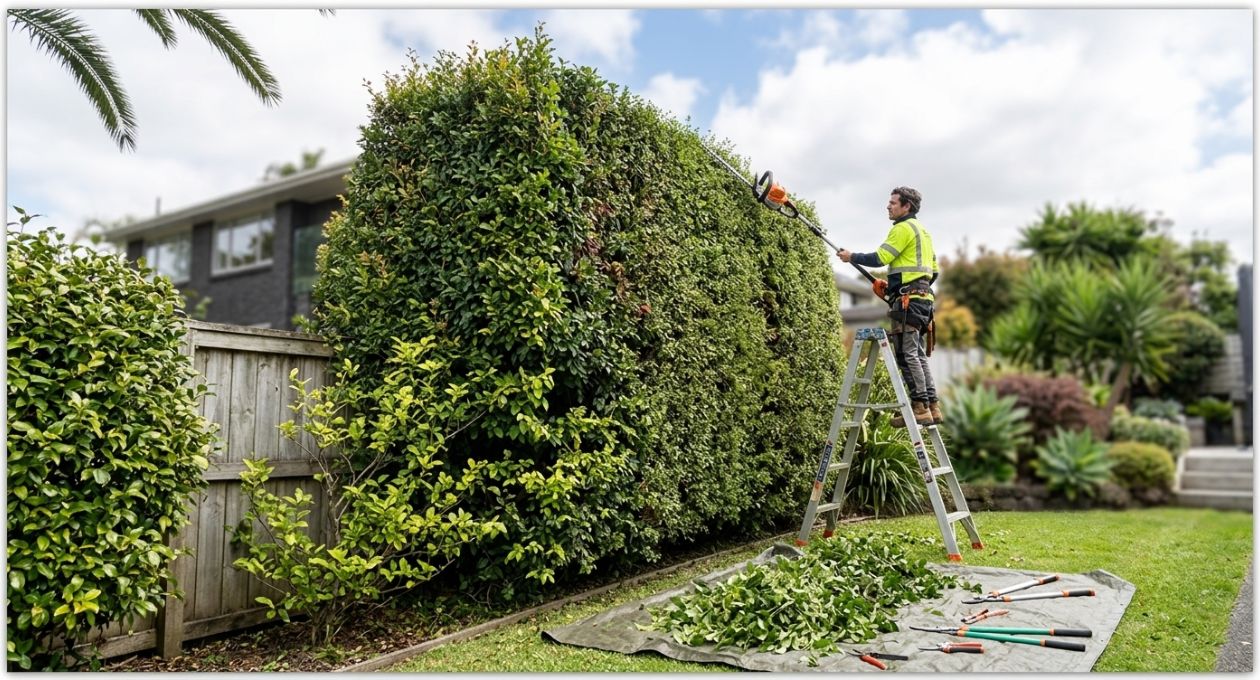
Sharp tools will give clean cuts, and the healing process will be faster:
- Hedge trimmers for basic cutting
- Secateurs for small branches
- Loppers for bigger branches
- Pruning saw for tough, woody branches
- Garden gloves and safety goggles
- A sturdy ladder if the hedge is high
- A tarpaulin or garden bags for the cuttings
When Should Overgrown Hedges be Trimmed?
The best time for more intense hedge trimming Auckland is usually late winter or early spring when growth has yet to start. Maintenance pruning is done either in late spring or summer based on the type of plant.
It is also advisable to look for nesting birds prior to any pruning as most birds nest within hedgerows during their breeding period.
If there are any doubts regarding when to prune a specific hedge, professional advice will come in handy.
Times When DIY Doesn’t Work
Although most homeowners can take care of basic hedge trimming on their own, there are times when overgrown hedges become more complicated.
If any of the following applies to your hedge, you should consider professional hedge trimming services:
- Very tall or hard-to-reach hedges
- Thick mature branches needing specialized tools
- Located in steep or tricky grounds
- Near power lines or neighboring properties
- Hedges in need of restoration work
- Hedges generating lots of green waste material
Keep Your Hedge Healthy After Trimming
It’s not over once you’re done with your pruning.
Watering the hedge during dry spells, adding mulch to the base of the hedge, and fertilizing as necessary are all steps that help in recovery. But equally as important is maintaining a trimming schedule for the hedge to avoid overgrowth.
Minor maintenance trimming is much better than a big restoration project for the health of the plant and the owner.
Need an expert hand on your delicate hedges? We can help. Get a free on-site visit and our certified arborists in Auckland will tell you if your hedge is diseased or healthy, and what can be done next.