Apple trees aren’t known as the best ones to flourish on their own; they might grow with time, but not grow well.
Branches overlap, the centre fills in and ultimately, the fruit grows small, uneven, or more difficult to reach than it should be.
In Auckland’s mild, humid climate, an overgrown canopy also holds onto moisture longer than it should, providing a breeding ground for fungal diseases. Proper pruning can resolve all these issues, but only if carried out at the right time and in the right way. Here’s how to do it.
Would you rather have it done for you? See our tree pruning in Auckland — free on-site quote from certified, fully insured arborists.
Qualified arborists
Want It Pruned Properly?
Correct cuts, the right season, and the full clean-up included — without taking more off the tree than it needs.
Why Pruning Matters for Apple Trees
Improved Fruit Quality and Production
A tree carrying too much has energy stretched thin. The pruning of non-producing branches will allow the tree to direct more energy toward the fruit that it produces, resulting in larger and better fruit at harvest time.
Improves Air Circulation and Disease Management
Auckland has a more humid and mild climate compared to other parts of New Zealand; therefore, fungal diseases have more chances of developing in a dense canopy. Tree pruning Auckland allows better air circulation within the canopy and aids in drying of the foliage faster after rainfalls.
Tree Shape and Improved Structure
Young trees with properly structured canopies result in better shapes in the long run that require less care from the growers.
When to Prune Apple Trees in Auckland
Optimal Pruning Timing
The optimal time for pruning apple trees is late winter when the tree is still dormant; this means about June to August before the buds start swelling. Pruning during the dormancy period allows the tree ample time to recover from the wounds prior to the start of the growing season; in addition, it lowers the chances of contracting any infections like fire blight.
When is your Tree Ready?
When the tree has shed its leaves and is now fully dormant, you can start pruning.
Consequences of Pruning Apple Trees at the Wrong Time
Pruning during active growth of the tree or when the buds are swelling is likely to cause stress and increase the probability of disease infections through the openings created by pruning. Try to avoid pruning during humid periods to prevent entry of fungal spores.
Tools You’ll Need
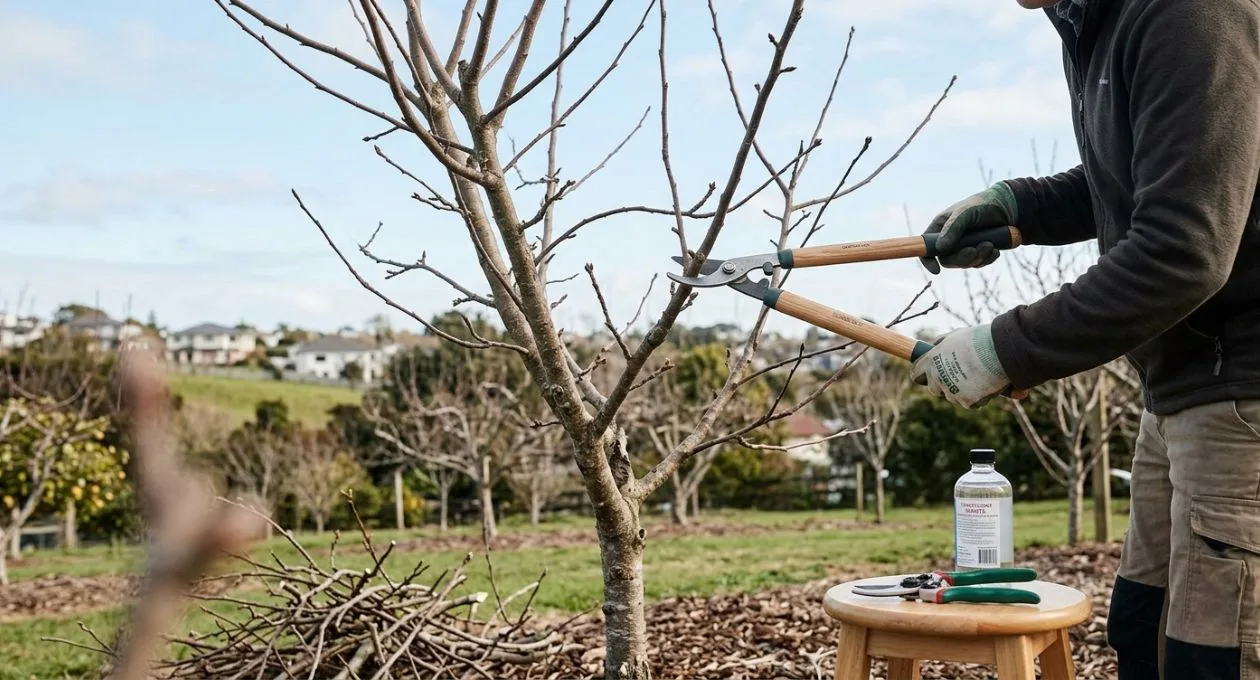
Proper tools are as important as proper technique. When tools are not sharp, the wood is torn instead of being cut clean, delaying the healing process and allowing diseases to easily enter.
- Secateurs for smaller branches and precision pruning
- Loppers for thicker branches that are difficult to reach with secateurs
- Pruning saw for large branches
- Disinfectant or methylated spirits for cleaning tools before making another cut, particularly if switching from one tree to another or if there is any sign of disease
Qualified arborists
Want It Pruned Properly?
Correct cuts, the right season, and the full clean-up included — without taking more off the tree than it needs.
Step-by-Step: How to Prune an Apple Tree
Step 1 — Remove Dead, Diseased, and Weak Wood First
This is the first step you should make no matter what kind of tree you are pruning. Dead and diseased wood is useless and can affect other parts of your tree.
Step 2 — Remove Crossing and Inward-Growing Branches
Wounds that can become entry points for the disease appear where branches cross and grow inward, so these branches need to go next.
Step 3 — Allow More Sunlight and Air
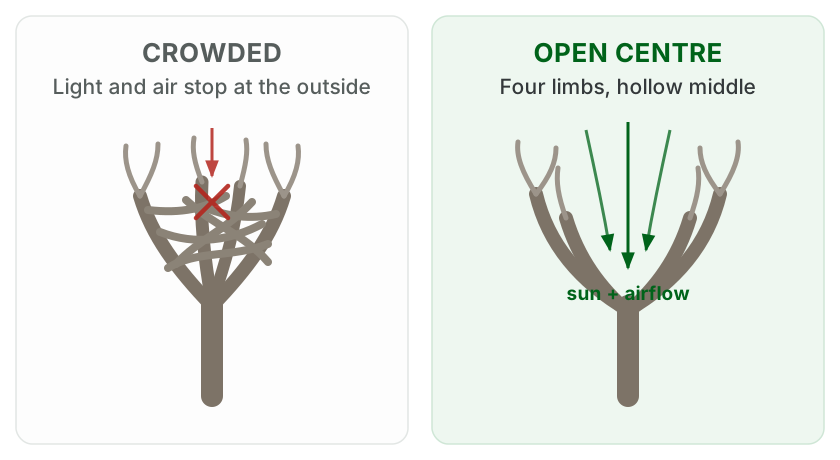
For apple trees, you need to create the shape that is similar to a vase. To do that, remove some of the interior branches to allow sun and air to enter the inner parts of the canopy.
Step 4 — Make the Canopy Compact and Lower it
Remove all the branches that have grown either too long or wide and make the tree look neat and compact. You shouldn’t perform the severe cutback of the branches during one season.
Step 5 — Prune Properly
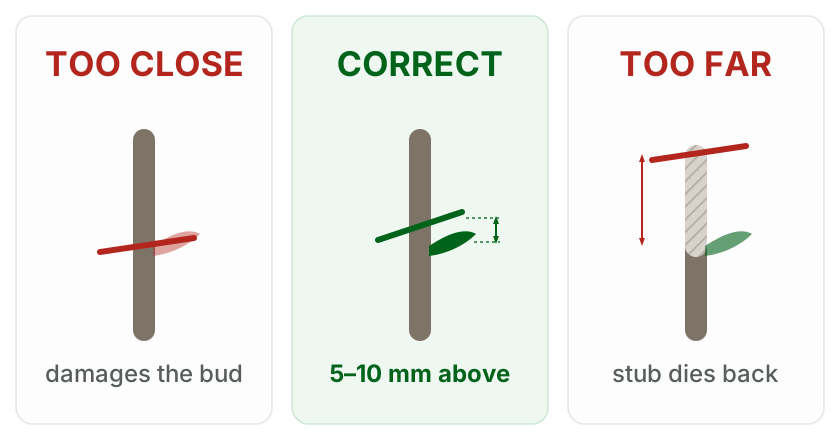
Each cut should be made in an angle near the outer bud. This way, the tree will continue to grow outward and the angle will prevent water from accumulating on the wound.
Common Pruning Mistakes to Avoid
Over-Pruning During a Single Year
If you prune too much wood all at once, you stress the tree and risk over-production in the coming year. Distribute your heavy-duty pruning work over two or three years, if your tree requires shaping.
Pruning Too Close or Too Far Away From the Bud
Pruning too close to the bud may harm it, while pruning too far away creates a stub that will die back and become prone to disease. Instead, make a clean angular cut right above the bud.
Neglecting Tools’ Hygiene
Not sanitizing your pruning tools between each cut, especially after contact with diseased wood, is probably the simplest way to infect other branches or even different trees with the disease.
For larger, mature or difficult-to-access apple trees, arborists in Auckland can provide the specialist equipment and knowledge needed to carry out pruning safely.
Caring for Your Apple Tree After Pruning
If you keep up with pruning every year, your next pruning procedure will turn into a light shaping process, not a major one. Those trees that are difficult to prune are usually the trees that have gone without pruning for a couple of seasons.
Feeding and Mulching
Mulch will ensure better water retention and help suppress weeds during the growing period, while feeding as the tree wakes up after dormancy will be beneficial for growth after the pruning procedure.
Regrowth
Monitor the tree’s response during spring and summer. Regrowth is vigorous in the wrong places (in the inner parts of the tree), for example, and can be dealt with using follow-up shaping in light terms rather than having to wait until the following winter pruning.